How We Review
Forex Brokers
How We Review Forex Brokers
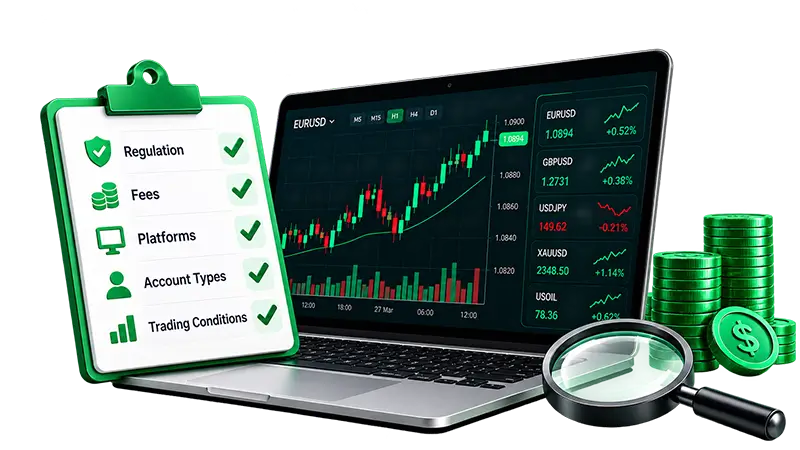
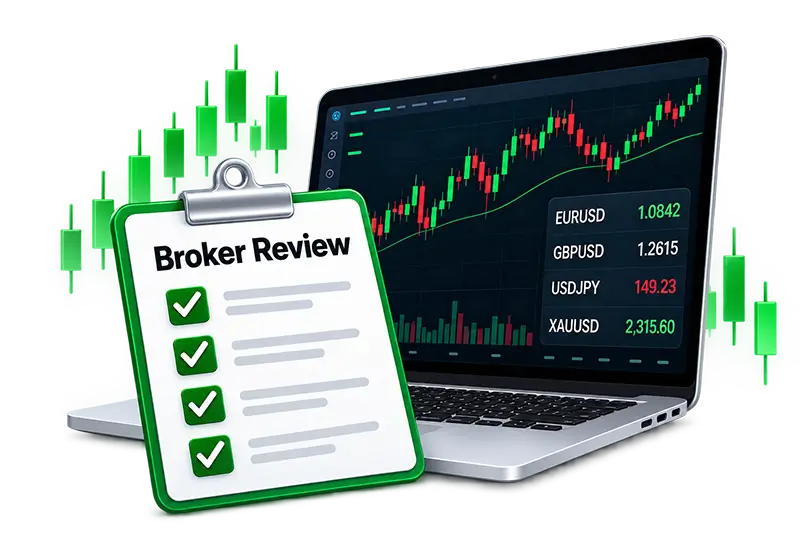
Best Forex Broker Reviews follows a structured process to evaluate every broker we cover. The same core method applies across every review, so you can compare brokers on equal terms.
- Regulation and legal entities
- Broker safety and client protections
- Spreads and commissions
- Account types
- Trading platforms
- Deposits and withdrawals
- Tradable markets
- Customer support
- Research and education
- Trading conditions
- Legal documentation
- First-hand testing, where available
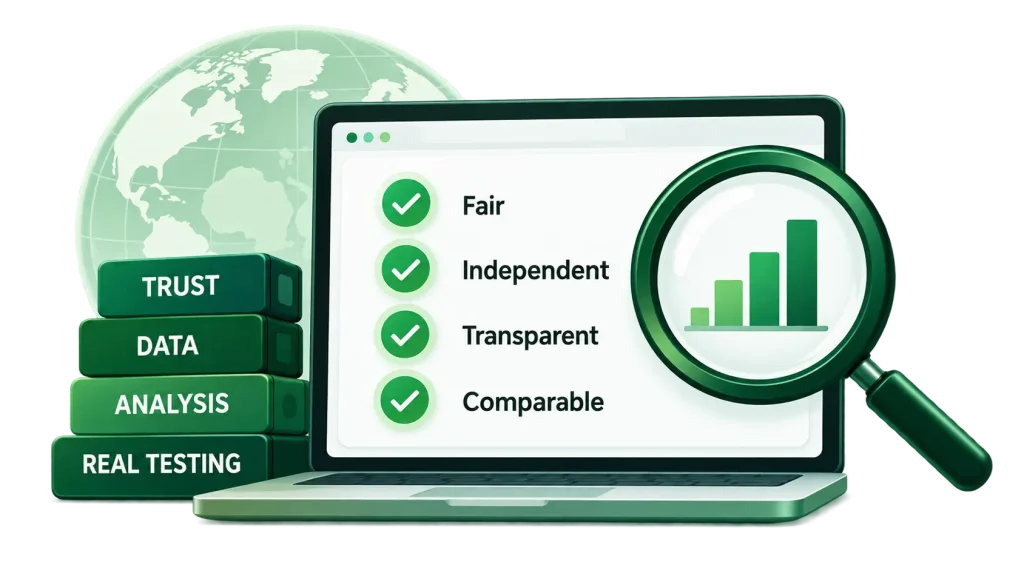
Not every piece of information carries the same weight. We label each fact by its source, so you know where it came from:

Independently Tested

Regulator-Verified

Broker - Stated

Not Publicly Disclosed
Our Forex Broker Review
Principles
✓
Our Forex Broker Review Principles
Accuracy
Every factual claim needs reliable evidence behind it. We don’t publish a figure or statement we can’t support.
Consistency
We apply the same core method to every broker. That’s what makes comparisons across reviews meaningful.
Recency
We revisit broker information when conditions change materially, not on a fixed schedule alone.
Transparency
We tell you where each piece of information came from and whether we verified it independently.
Editorial Independence
Commercial relationships don’t change what we find or how we review. A broker’s ad spend has no bearing on its rating.
Our Forex Broker Review
Process
✓
Our Forex Broker Review Process
Here’s how a broker review gets built, step by step.
Step 1: Identify the Broker and Legal Entity
We confirm the registered company name, the operating company, the country of incorporation, related group companies, which entity serves which jurisdiction, and the terms and conditions that apply to each.
Step 2: Verify Regulation
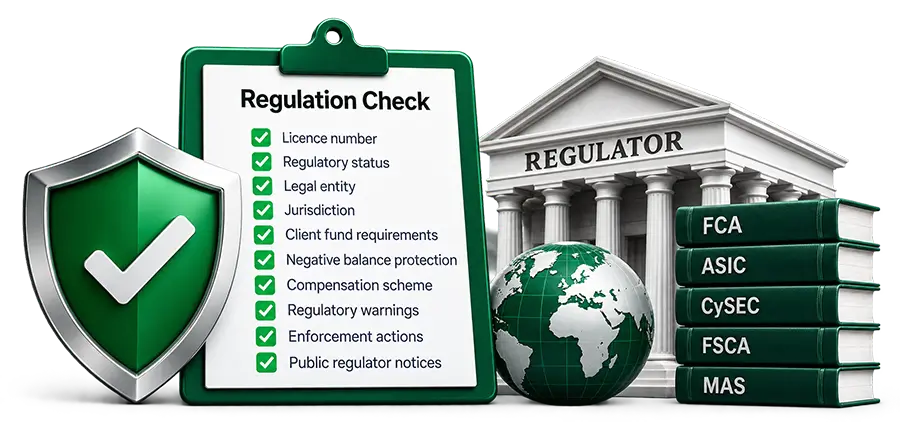
We check broker licences against official regulator registers wherever those registers exist. Regulators we check against include the FCA, ASIC, CySEC, FSCA, DFSA, MAS, NFA, CFTC, FMA, and others relevant to the broker’s operating entities. Investor protections differ between regulators and jurisdictions, and we note that where it matters.
Step 3: Review Trading Conditions
We check account types, minimum deposit, leverage, margin requirements, base currencies, demo account availability, Islamic or swap-free accounts, professional accounts, and regional restrictions.
Step 4: Review Trading Costs
We check spreads, commissions, swap fees, overnight financing, currency conversion fees, deposit fees, withdrawal fees, inactivity fees, and other non-trading charges.
Step 5: Review Trading Platforms
We assess the platforms a broker offers, along with their tools, functionality, and accessibility.
Step 6: Review Funding, Markets, and Support
We examine deposit methods, withdrawal methods, tradable assets, customer support, research tools, and educational resources.
Step 7: Fact-Check and Publish
Before a review goes live, we verify important claims, confirm regulatory details, review pricing information, check sources, complete an editorial review, and record the review date.
Step 8: Monitor and Update Reviews
We regularly check for changes in broker regulations, trading conditions, fees, and services to keep our reviews accurate and up to date.
How We Verify Forex Broker Regulation
Regulation is one of the most important things we check, so we treat it as a priority.
We check the licence number, regulatory status, legal entity, jurisdiction, client fund requirements, negative balance protection, compensation scheme eligibility, regulatory warnings, enforcement actions, and public regulator notices.

Regulation Does Not Remove Trading Risk
Regulation gives you oversight and certain protections. It does not remove trading losses, market risk, or counterparty risk.
A well-regulated broker can still be a poor fit for your strategy, and regulation doesn’t guarantee profit or protect you from normal market volatility.
Regulation Does Not Remove Trading Risk
We assess regulatory oversight, legal transparency, company history, client fund protections, risk disclosures, regulatory warnings, enforcement history, ownership transparency, and any security information the broker discloses.
We don’t use absolute language like “100% safe,” “completely safe,” or “risk-free broker.” No broker can honestly claim that, and we won’t either.
How We Evaluate Forex Broker Fees
Spreads
We check advertised or observed spreads where they’re available, and note whether they’re fixed, variable, raw, or account-specific.
Commissions
We check per-side commission, round-turn commission, commission-free account options, and volume-based pricing.
Swap and Overnight Fees
We review financing costs where brokers disclose them publicly.
Non-Trading Fees
We check withdrawal fees, deposit fees, inactivity fees, conversion fees, and account maintenance fees.

How We Label Cost Information
Every figure gets labelled by source:

Independently Tested

Broker-Stated

Publicly Published
Estimated

Not Publicly Disclosed
How We Evaluate Trading Platforms
We review platforms including MetaTrader 4, MetaTrader 5, cTrader, TradingView integrations, proprietary platforms, web platforms, and mobile apps.
We assess ease of use, charting, order types, technical indicators, mobile usability, trading tools, stability, research integration, automated trading support, and platform availability by country.
How We Evaluate Forex Broker Account Types
We review standard accounts, ECN accounts, raw spread accounts, STP accounts, commission-based accounts, Islamic accounts, demo accounts, professional accounts, and VIP accounts.
We compare minimum deposit, spread structure, commission, leverage, minimum lot size, platform access, and tradable markets across account types.
How We Evaluate Deposits and Withdrawals
We review available payment methods, minimum deposit, minimum withdrawal, processing times, deposit fees, withdrawal fees, base currencies, country availability, and withdrawal restrictions.
Payment methods vary by broker and region, and can include bank transfer, debit cards, credit cards, e-wallets, and local payment systems.
We distinguish clearly between the processing times a broker states and any withdrawal times we’ve independently tested.
How We Evaluate Customer Support
We assess live chat, email, phone support, support hours, available languages, response time, helpfulness, accuracy, and availability by region.
Where we’ve tested support directly, we record the date, the contact method, the question asked, and the quality of the response.
How We Evaluate Tradable Markets
We assess live chat, email, phone support, support hours, available languages, response time, helpfulness, accuracy, and availability by region.
Where we’ve tested support directly, we record the date, the contact method, the question asked, and the quality of the response.
How We Evaluate Research and Education
We assess live chat, email, phone support, support hours, available languages, response time, helpfulness, accuracy, and availability by region.
Where we’ve tested support directly, we record the date, the contact method, the question asked, and the quality of the response.
How We Evaluate Tradable Markets
We check whether a broker offers forex, indices, commodities, stocks, ETFs, cryptocurrencies, futures, bonds, and CFDs.
We’re clear about the difference between CFD trading and owning the underlying asset. They’re not the same thing, and mixing them up matters when you’re deciding where to put your money.
How We Evaluate Research and Education
We assess market analysis, economic calendars, forex news, technical analysis, trading signals, webinars, trading courses, beginner guides, platform tutorials, and research tools.
We focus on whether the content is actually useful, not on how much of it a broker has produced.
How Our Forex Broker Rating System Works
| Category | What We Assess |
|---|---|
| Regulation & Safety | Regulation, legal entities, and client protections |
| Fees & Costs | Spreads, commissions, swaps, and non-trading fees |
| Trading Platforms | Platform quality, usability, and tools |
| Account Types | Account options and trading conditions |
| Tradable Markets | Range of available instruments |
| Funding | Deposit and withdrawal options |
| Customer Support | Availability and service quality |
| Research & Education | Market analysis and educational resources |
Rating Transparency
We’re still finalising the exact weighting each category carries in a broker’s overall score. Once that weighting is set, we’ll publish it here. We won’t invent percentages just to make this page look more detailed than the process actually is.
How We Handle Missing Information

- Not publicly disclosed
- Not independently verified
- Broker-stated
- Unable to confirm
- Not available in this jurisdiction
- Information unavailable at the time of review
What We Test First-Hand
We don’t currently run first-hand testing on live or demo trading accounts. Our reviews are built from official broker documentation, regulator records, and other publicly available sources, labelled accordingly wherever they appear on this site.
We’re working toward adding direct testing — demo accounts, platform functionality, mobile apps, customer support response, and account registration — to strengthen future reviews. Until that testing is in place, we won’t claim it, and any review that includes tested information will say so explicitly.
Some of what appears in our reviews comes directly from the broker: their website, terms and conditions, legal documents, account pages, fee schedules, product disclosure documents, help centres, customer support, and platform documentation.
Broker-provided information isn’t automatically the same as independently verified information. We label it as broker-stated so you know the difference.
What Information Comes From Brokers

- Official regulator databases
- Government or regulatory notices
- Legal and regulatory documents
- Official broker terms and conditions
- Broker customer-support confirmation
- Platform documentation
- Reliable independent sources
How We Handle Conflicting Information
When sources disagree, we go with the stronger evidence, in this order:

Regulator records

Legal documents

Official broker documentation

Broker support

Reliable secondary sources
If we still can’t resolve a conflict, we say the information couldn’t be independently confirmed. We don’t pick a side to make the page read cleaner.
How Our Forex Broker Rating System Works
How Often We Update Forex Broker Reviews
We monitor the information behind our reviews and revisit pages when something material changes. Triggers include regulatory changes, ownership changes, new account types, pricing changes, new trading platforms, leverage changes, deposit requirement changes, payment-method changes, product availability changes, and country restrictions.
Every review shows:
- Not publicly disclosed
- Last Reviewed
- Last Updated:
Material Changes That Can Trigger an Update
Some changes are significant enough that we reassess a review sooner than our normal cycle. These include a licence suspension, a regulatory warning, an ownership change, a major platform change, a significant fee change, an account discontinuation, a withdrawal-policy change, a broker’s exit from a market, or a new legal entity.
Our Corrections Policy
Identify the error
verify the evidence
correct the information
editorial review
update the page

Affiliate Relationships & Editorial Independence
Best Forex Broker Reviews may use affiliate links, and we may receive compensation from some brokers we cover. That compensation doesn’t change what we find. Brokers can’t buy a higher rating, and commercial relationships are disclosed. Sponsored content is clearly labelled as sponsored.
See our Affiliate Disclosure for details.
Our Conflict-of-Interest Policy
- Commercial partners follow the same core methodology as every other broker we review
- Sponsored relationships are disclosed
- Reviewers disclose any relevant financial relationships
- Broker requests don’t automatically change a rating
- Corrections require supporting evidence
- Commercial teams don’t override editorial findings

Limitations of Our Broker Reviews
Broker conditions change. Spreads fluctuate. Pricing differs by account type. Leverage varies by jurisdiction. Available products differ by country. Payment methods vary geographically. Platform features change over time. Live-account testing isn’t yet available for every broker we cover. Regulatory protections vary by legal entity, even within the same broker group.
A review reflects what we found at the time we published or last updated it. It won’t reflect every individual trader’s circumstances, and it shouldn’t replace your own due diligence.
Who Writes and Reviews Our Broker Content


How to Use Our Forex Broker Reviews
No broker is automatically right for every trader. Before you decide, consider your country, the broker’s legal entity, the regulatory protection that applies to you, your trading experience, your trading strategy, your preferred platform, the markets you need, your trading costs, your deposit size, your payment methods, and your customer-support needs.
Explore more
Our Editorial Responsibility
Ready to Compare Forex Brokers?