

Best Forex Brokers Review


Best Way to Learn Forex Trading: Your Complete Roadmap

The best way to learn forex trading is to follow a structured plan: understand the market, learn your platform, practise a clearly defined strategy on demo, and review your results before considering real money.
Opening a trading account takes minutes. Understanding what each trade could cost takes more work. A useful education connects the two, so you can explain your exposure and decisions before pressing buy or sell.


This roadmap covers the foundations, learning resources, practice routines, and Australian checks that help you study with purpose. You do not need to learn every indicator or buy an expensive course to begin.

sangram mohanta

Written by

Sangram Mohanta

rex john walsh

Fact checked by

Rex John Walsh

best forex brokers 2026
Publicly Published

Check Country Eligibility

Trading Costs Verified

Compare Trading Conditions

Review Local Arrangements

Understand Funding & Withdrawals

Best Forex Brokers List 2026

✓

Welcome to IC Markets
True ECN Forex Broker
Minimum Deposit $200
No Deposit Bonus
5.0 rating
5.0
Location: NSW, Australia.
Welcome to FxPro
Trade Like a Pro
Minimum Deposit $100
No Deposit Bonus.
4.5 rating
4.5
Location: Basinghall, England.
Welcome to FBS Markets
Reliable Forex Broker
Minimum Deposit $1.00
100% Deposit Bonus
4.5 rating
4.5
Location: Belize, C.A
Welcome to Axi
Trade with a Trusted Broker
Minimum Deposit $10
No Deposit Bonus.
4.5 rating
4.5
Location: Sydney, Australia.
Welcome to HFM
World Leader in Financial Trading
Minimum Deposit $100
100% Deposit Bonus.
4.0 rating
4.0
Location: Beachmont, Kingstown.
Welcome to FP Markets
Best Forex & CFD Trading Provider
Minimum Deposit $100
No Deposit Bonus.
5.0 rating
5.0
Location: Australia

What Is the Best Way to Learn Forex Trading?

✓

A practical approach combines explanation, application, and review. Read about a concept, practise it in a controlled setting, then check whether you understood it. Watching more lessons is useful only when that knowledge improves your decisions.

Secure Finance Globe Illustration

Start With a Learning Plan That Fits Your Experience

Begin with an honest skills check. Can you explain a currency quote, calculate a position's value, and describe what happens when a stop-loss order triggers? If those tasks are unfamiliar, start with the foundations.

Separate platform skills from trading judgement. Knowing how to submit an order does not establish whether the order makes sense. Your plan should cover both, with study sessions that fit around work, family, and sleep.

Trading Costs Verified

Set Goals You Can Control

Choose goals such as calculating five position sizes correctly, completing a platform exercise, or documenting every practice trade. These produce evidence of learning.

A daily profit target does not tell you whether you followed a sound process. A careless trade can win, while a correctly executed trade can lose. Review your decisions alongside the financial outcome, and avoid judging progress from a short winning streak.

Learn Forex Trading From Scratch: Understand the Basics First

✓

To learn forex trading from scratch, first understand the product, its price, and its costs. A chart shows movement, but the account terms determine how that movement affects your balance.

Understand What You Are Actually Trading

Exchanging Australian dollars for holiday spending involves obtaining another currency. Speculating through a forex CFD involves a contract linked to an exchange rate; it does not give you ownership of the underlying currency. Product structures differ, so read the provider's disclosure documents. Moneysmart explains the distinction and risks.

Currency pairs have a base currency and a quote currency. In EUR/USD, EUR is the base. A quote of 1.1000 means one euro is worth US$1.10. Buying the pair expresses an expectation that the euro will strengthen against the dollar; selling expresses the reverse.

Our Forex Broker Reviews

Make Sense of Pips, Lots, and Trading Costs

A pip commonly means a movement of 0.0001 for pairs such as EUR/USD. For many yen pairs, it means 0.01. Check the instrument specification because platforms may also display smaller fractional points.
For a conventional forex contract, one standard lot is 100,000 base-currency units. A 0.01-lot EUR/USD position therefore represents €1,000, with a pip value of US$0.10.

Suppose that position gains 20 pips before costs. The gross gain is 20 × US$0.10 = US$2.00. If the assumed spread cost is US$0.10 and round-trip commission is US$0.06, the simplified net gain is US$1.84. These costs are hypothetical, not a broker quote. The example excludes overnight charges, slippage, and currency conversion.

Secure Finance Globe Illustration

Learn Leverage and Margin Before Placing an Order

Leverage lets you control exposure larger than the margin committed. At 30:1 leverage, US$3,000 of exposure requires US$100 of initial margin, assuming no additional requirements.

Margin is not your planned loss. A 1% adverse move on US$3,000 produces a US$30 loss before costs, equal to 30% of that US$100 margin. At a fixed position size, changing leverage changes the required margin, not the monetary loss per pip. As losses reduce account equity, the provider may close positions under its margin rules. Understand those rules before choosing a trade size.

How to Start Learning Forex Trading Without Feeling Overwhelmed

✓

Give each study session one practical task. Connect what you read or watch to an exercise, then review what you understood and where you made mistakes.

Forex Brokers for Beginners

Create a Weekly Learn, Practise, and Review Routine

For example, study stop-loss orders, practise placing and modifying them, then compare intended exits with recorded results. Keep a short list of unresolved questions. Answer those before adding another tool or strategy.

Available Markets

Choose One Currency Pair and a Consistent Study Window

Studying one pair initially reduces the number of changing variables. Record its spread, price range, and behaviour during your chosen window rather than assuming every pair behaves alike.

Forex activity varies across the Asian, European, and North American sessions. Economic releases can also change conditions abruptly. Use an economic calendar and record relevant events. For broader background, explore the forex trading guide alongside your practical exercises.

Choose Learning Resources That Explain the Details

✓

The best resources to learn forex trading should help you answer a specific question or complete a task. Judge them by clarity, verifiable information, and practical usefulness rather than popularity alone.

How We Handle Missing Information

Find Books That Build Knowledge

One foundation title to assess is Currency Trading For Dummies, fourth edition, by Paul Mladjenovic, Kathleen Brooks, and Brian Dolan. The book's title page identifies its authors and edition. Treat any book as a learning source, not evidence that its methods will be profitable. Check older platform instructions and regulatory details against current official information.

What We Test First-Hand

Choose YouTube Channels

The best YouTube channels to learn forex trading explain decisions before the outcome is known. Prefer complete lessons that show entry conditions, invalidation, costs, and losing examples. Check who produces the videos and how they earn money. Broker videos can explain platform functions, but their commercial purpose matters. Likewise, a creator selling signals has a different incentive from someone teaching independent analysis. Moneysmart's finfluencer guidance explains checks for credentials and paid promotions.

Find the Best Forex Trading Course for Beginners

✓

The best forex trading course for beginners is one that matches your knowledge gaps and gives you work to complete. A polished sales page cannot show whether you will learn to manage an order or evaluate a strategy.

reliable secondary sources

What a Beginner Course Should Actually Teach

Look for a sequence covering currency quotes, product structure, costs, order types, leverage, position sizing, strategy rules, and trade review. Exercises should require calculations and decisions, not just video completion.
Check instructor experience, sample lessons, support arrangements, and refund terms. If performance claims are central to the pitch, ask what records support them and whether costs and losses are included. Trading experience alone does not establish teaching quality.

broker support

Free or Paid: Decide What You Need Help With

You can learn forex trading online for free through educational lessons, official manuals, and demo practice. IG Academy, for example, lists free courses covering orders, leverage, analysis, and risk management. It is broker-produced education, so distinguish lessons from product promotion.

Assess free and paid courses using the same criteria. Payment may buy feedback or structured assignments, but it does not prove educational quality. Identify the missing service before paying for it.

Regulation and Legal Entity

Spot Course Claims That Deserve Closer Scrutiny

Avoid programmes built around guaranteed income, secret methods, or pressure to enrol immediately. Selected profit screenshots do not establish typical outcomes or a reliable trading record.

Read the full price, including subscriptions, software, and private groups. Education should develop your ability to make and review decisions. A service that simply tells you what to buy or sell does not provide the same learning process.

Choose a Platform You Can Understand and Control

✓

The best app to learn forex trading is one on which you can understand exposure and manage orders accurately. Familiarity matters more than a long feature list.

What We Test First-Hand

Check the Controls Before Comparing Advanced Features

Before submitting a practice trade, locate position size, account currency, spread, stop-loss, take-profit, margin, and close-position controls. Check whether size is entered in lots, units, or another format.

Distinguish closing a position from cancelling a pending order. Also learn the difference between balance and equity. The official MetaTrader 5 help pages explain its trading operations; use the equivalent documentation for whichever platform you choose.

Decide Where Mobile and Desktop Practice Fit

A phone can be convenient for checking positions. A larger screen may make chart study, calculations, and journal review easier. Use the device that lets you complete the task without rushing or misreading information.

Test the platform's demo access, tutorials, and trade-history export. Practise checking order details before confirmation, especially where one-click trading is available. Verify that the instruments and controls you need are supported by your specific account.

Learn Forex Trading With a Demo Account

✓

You can learn forex trading with a demo account without putting trading capital at risk. Its main value is the chance to practise a process and identify mistakes before money is involved.

Set a Demo Balance That Matches Your Intended Budget

Choose a plausible balance and leverage setting. Practising with an enormous virtual account can hide the effect that minimum trade sizes would have on a smaller live account. Check demo expiry, inactivity, reset, and platform conditions. The forex demo accounts page offers a starting point for comparisons; confirm current terms with each provider. A demo balance is virtual and cannot be withdrawn.

Account Terms Checked

Practise the Full Trade Process

If you are deciding how to practise forex trading, rehearse the whole sequence: check conditions, identify a valid setup, calculate size, place the order, manage it according to the plan, and document the outcome. Include exercises for cancelling pending orders, modifying stops, and closing positions. Record operational errors separately. Accidentally entering ten times the intended size is a platform mistake that deserves attention even if the trade wins.

Inactivity Fees

Understand What Demo Results Cannot Establish

Demo and live conditions may differ in fills, slippage, spreads, and available liquidity. Virtual losses also carry different emotional consequences from losing money needed elsewhere. Do not reset an account simply to erase poor results. Retain the record and investigate what happened. A demo winning streak does not establish that a strategy will remain profitable, nor does smooth demo execution prove the provider's withdrawal reliability.

How to Learn Forex Trading Step by Step With One Strategy

✓

Study one clearly specified setup long enough to evaluate it. Constantly changing methods make it difficult to identify what caused your results.
How We Evaluate Broker Safety

Learn What Charts and Economic News Can Tell You

Technical analysis examines price behaviour, including trends, ranges, and support or resistance. Fundamental analysis examines influences such as interest rates, inflation, and central-bank decisions.

Start by describing observations accurately. A price closing above a previous high is observable; continued buying is a prediction. News can change both price and execution conditions. Use the beginner forex strategies guide for background, then translate any approach into testable rules.

Our Forex Broker Reviews

Write Clear Entry, Exit, and Invalidation Rules

Your written specification should identify the currency pair, chart interval, qualifying conditions, entry trigger, stop, target, and setup expiry. Invalidation means the condition that makes the original trade idea no longer applicable.

Define skip conditions too, such as spreads above a stated limit or an approaching economic announcement. Someone reviewing your charts should be able to understand why a trade qualified. Vague instructions such as buying when momentum looks strong are difficult to test consistently.

How We Evaluate Broker Safety

Test the Rules Before Adjusting Them

Choose a historical period and record every qualifying setup. Include losing trades, realistic spreads, commissions, and assumptions about fills. Avoid using information that would not have been available at entry.

This guards against hindsight bias. Overfitting occurs when repeated adjustments make a strategy match past data unusually well without improving its usefulness elsewhere. Keep a separate period for checking the unchanged rules. Treat promising results as evidence to investigate, not proof of future returns.

Make Risk Management Part of Every Practice Trade

✓

Risk management connects your trade idea to the amount you could lose. Learn that calculation alongside entries, so controlling exposure becomes part of the routine.
Our Forex Broker Reviews

Calculate Position Size From the Planned Risk

Consider a hypothetical US-dollar account holding US$1,000, a chosen risk budget of 0.5%, and a EUR/USD stop 20 pips from the expected entry fill. The risk budget is US$5. This percentage is an example, not a recommendation.

At US$10 per pip for one standard lot, the size before commission is: Position size = US$5 ÷ (20 pips × US$10 per pip per standard lot) = 0.025 lots. If the account permits only 0.01-lot increments, rounding down gives 0.02 lots. Its planned price loss is US$4. At an assumed round-trip commission of US$7 per standard lot, commission adds US$0.14, bringing the planned total to US$4.14 before slippage or financing.

Here, the 20-pip distance runs from the expected opening fill to the expected stop fill, so do not add the same spread again. If measuring from chart prices instead, adjust the assumptions for the relevant bid and ask. A normal stop-loss does not guarantee the execution price.

Set Limits for Individual Trades and Losing Periods

Define a maximum planned risk per trade, total open exposure, and a point at which you pause to review losses. These limits should be affordable within your circumstances.

Consider correlated positions. Buying EUR/USD and GBP/USD can create overlapping exposure to a weaker US dollar. Several separate tickets may therefore express much the same idea. Never assume that a larger number of positions automatically spreads risk.

Use a Trading Journal to Measure Progress

✓

A journal makes it possible to compare intention with action. It also helps separate a weak strategy from mistakes in applying it.

Record Enough Detail to Explain Each Result

Record the date, time zone, instrument, setup, size, entry, stop, target, costs, and actual exit. Add screenshots and note relevant announcements. Save the reason for entry before you know the outcome.

Afterwards, classify the trade: a valid setup followed correctly, a rule breach, or an execution problem. This prevents a profitable mistake from becoming an excuse to abandon the plan.

Look Beyond Your Win Rate

Win rate measures how often trades win. It leaves out how much they win or lose. Expectancy combines those figures:

Expectancy = (win probability × average net win) − (loss probability × average net loss).

For example, a 40% win rate with average net wins of US$15 and average net losses of US$8 gives an expectancy of (0.40 × US$15) − (0.60 × US$8) = US$1.20 per trade. Express losses as positive amounts in this formula and include costs consistently.

Also examine drawdown, the decline from an equity peak to a later trough. Check whether one unusually large win explains most of the apparent success. A small sample offers limited evidence.

Turn Recurring Mistakes Into Specific Practice Tasks

Replace vague promises to be disciplined with a concrete action. If you chase prices, require a written entry condition. If you keep moving stops farther away, rehearse accepting the original exit without changing it. Review one recurring problem at a time. If trading becomes compulsive or begins affecting essential spending, stop trading and address that behaviour before considering further practice with money.

The Best Way to Learn Forex Trading in Australia

✓

The best way to learn forex trading in Australia includes understanding the local product rules and checking the company that will hold your account. An Australian-looking website or familiar brand name does not establish which entity you will contract with.
Australian Securities and Investment Commission

Understand the Product and Check the Provider

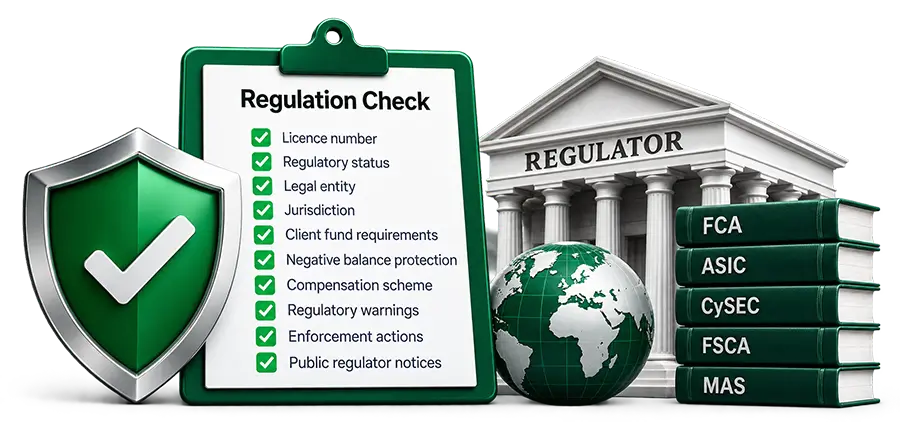
Find the legal entity in the client agreement and compare it with ASIC's professional registers. Check its licence status, relevant authorisations, website details, and complaints process. Read the Product Disclosure Statement and Target Market Determination where applicable.

Caption: “ASIC Professional Registers Search interface. Source: ASIC’s July 2025 user guide; example records shown.”
Current Australian retail CFD protections include leverage limits of 30:1 for major currency pairs and 20:1 for minor currency pairs, margin close-out requirements, and negative balance protection. These protections apply within the relevant retail framework; they do not remove the possibility of losing the account balance. ASIC describes the existing measures.


On 12 October 2026, ASIC proposed extending and amending its CFD intervention order. As of this article’s verification date, those changes were a consultation proposal, not final rules. Read ASIC’s announcement.


Check whether you are classified as retail or wholesale. Moneysmart explains that wholesale clients may lose protections and generally cannot access external dispute resolution through AFCA. Do not accept reclassification merely to obtain higher leverage. Review the CFD guidance.

Plan Study and Practice Around Australian Time Zones

Use your actual location when planning sessions. Sydney and Perth do not share the same local time throughout the year. Australian, UK, and US daylight-saving changes can also shift the local timing of overseas market activity.

Convert calendar events into your local zone and label journal entries consistently. Choose a practice window that you can maintain without sacrificing sleep. You do not need to observe every session to learn a defined method.

Keep Records From the Start

Save statements, trade confirmations, deposits, withdrawals, fees, and currency-conversion records. Keep live and demo results separate, and preserve original transaction currencies alongside any reporting conversions. Tax treatment depends on the product and your circumstances. Consult the ATO's current guidance and a qualified tax professional about your trading records and reporting obligations. Do not assume that every trading gain receives capital-gains treatment.

How Long Does It Take to Learn Forex Trading?

✓

There is no reliable deadline for becoming a forex trader. Understanding basic terminology, operating a platform, and evaluating a strategy are different tasks, with different demands on your time.

Measure Readiness Through Skills Instead of a Deadline

You should be able to explain the product, calculate exposure, and show why a practice trade met your rules. You also need records covering losses and ordinary trading conditions, rather than selected highlights.
When asking how long it takes to learn forex trading, separate course completion from demonstrated competence. Studying regularly can improve familiarity, but elapsed time alone cannot establish a trading advantage.

Build a Flexible Learning Roadmap

Use these stages as a sequence, not a deadline. Repeat an exercise whenever you cannot explain the result.

Compare Forex Brokers

Decide Whether You Are Ready to Trade With Real Money

✓

Live trading is optional. Completing lessons creates no obligation to fund an account, and a profitable demo record does not make live trading suitable for everyone.

Review Your Knowledge, Records, and Financial Limits

Before considering a live account, confirm that you can calculate trade risk, explain costs, manage orders, and follow written rules. Review whether your sample includes unfavourable periods and whether the results remain meaningful after expenses. Keep essential spending and emergency savings outside the trading budget. Borrowing to fund practice adds repayment pressure to an already uncertain activity. Review the different forex account types, then confirm current specifications with the contracting provider.

Start Within Clear Limits and Review What Changes

If live trading is appropriate for your circumstances, define the maximum amount you can afford to lose and the conditions for stopping. Check whether the smallest available position fits your planned risk. A low deposit requirement does not establish that it does. Compare actual spreads, fills, commissions, and behaviour with your demo assumptions. Return to demo practice if operational mistakes recur or you cannot follow the plan. Increasing size to recover a loss can make the next loss harder to absorb.

Frequently Asked Questions

✓

These answers address practical questions about resources, practice accounts, and learning expectations.

Yes. Use a structured curriculum, practical exercises, and complete records. After studying position sizing, work through calculation examples; after learning order types, practise them on a demo account. Written rules make your decisions easier to examine.
Yes. Free lessons, official platform manuals, and demo tools can cover much of the foundation. Check access conditions: some advanced lessons or feedback require payment. Free access doesn’t guarantee quality, and payment doesn’t guarantee a profitable method.
Neither is required to begin. A mentor may help with a specific problem if they provide relevant feedback. Before paying, establish what support includes and whether the service teaches independent decisions or mainly sells signals.
Demo trading uses virtual funds, so you do not need trading capital for those exercises. For live trading, check the deposit minimum, smallest position, costs, and affordable risk. The smallest permitted deposit may be unsuitable for your planned trades.
Learn product mechanics and risk first. Then combine basic chart reading with an understanding of scheduled economic events. Neither approach removes uncertainty or replaces testing.
Look for identifiable authors, dated information, disclosed commercial interests, and claims you can verify. Prefer resources that explain costs and losing outcomes. Check regulatory statements against official records.
IG Academy offers free courses on orders, leverage, analysis, and risk, but it is broker-produced education. The MetaTrader 5 manual explains platform operations rather than whether a strategy is profitable. Choose a resource for the task you need to complete.
An individual trading day can produce a US$100 gain, but forex cannot be relied on to deliver that amount every day. Results vary, losses occur, and an income target does not establish a trading advantage.
Analysis, position sizing, execution, and risk control involve skills. Individual outcomes remain uncertain, and a winning trade can result from luck. Judge your process across a complete record rather than one result.
Choose a demo that supports the platform, instruments, realistic balance, and position sizes you intend to study. Check fixed expiry and inactivity rules separately. FxPro’s official FAQ, for example, states that demo accounts deactivate after 60 days; this is not a rule for other providers or proof of Australian availability. Confirm terms for your location and chosen platform before registering.
Check an economic calendar before each trading session. Focus on announcements affecting your currency pair, including interest-rate decisions, inflation, and employment data. Convert release times into your local time zone.
Common mistakes include risking too much, confusing margin with potential loss, ignoring costs, chasing prices, and moving stops farther away. Turn each recurring mistake into a specific demo exercise before increasing exposure.

Best Forex Broker Ratings & Comparison

Compare ratings, platform quality, and key features to find the best broker for your trading needs.

IG

☆ Overall Rating 5.0/5
▣ Mobile Trading ★★★★★
◇ Trading Fees ★★★★★
♧
SpotlightNo promotion is available at this time.
View Broker →

FP Markets

☆ Overall Rating 5.0/5
▣ Mobile Trading ★★★★★
◇ Trading Fees ★★★★★
♧
SpotlightRaw spreads, strong platform choice.
View Broker →

IC Markets

☆ Overall Rating 4.9/5
▣ Mobile Trading ★★★★★
◇ Trading Fees ★★★★☆
♧
SpotlightTight spreads and fast execution.
View Broker →

FxPro

☆ Overall Rating 4.5/5
▣ Mobile Trading ★★★★☆
◇ Trading Fees ★★★★☆
♧
SpotlightMulti-platform access and established brand.
View Broker →
♢ Trading CFDs involves risk. Retail investor accounts may lose money.
Top Forex Brokers Review